
A thought can feel true simply because it appears, not because it has been examined.
There are moments when the mind moves so quickly that it begins to shape reality before there is time to question it. Interpretations form instantly. Assumptions settle in quietly. And over time, what is repeatedly thought starts to feel like fact, even when it is only one version of what could be understood.
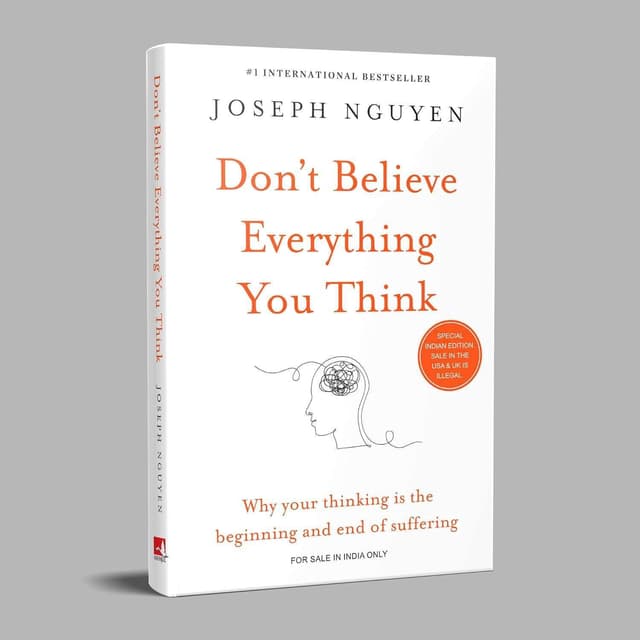
Don’t Believe Everything You Think by Joseph Nguyen explores the relationship between thinking and emotional experience, focusing on how unexamined thoughts can create unnecessary suffering. It presents the idea that many internal struggles are not caused directly by external events, but by the meaning assigned to those events through habitual patterns of thinking.
What the book emphasizes is not the need to control thoughts, but the importance of recognizing them as transient mental activity rather than fixed truth. This shift changes the relationship with the mind itself, creating space between what is experienced and what is believed about that experience.
Here are three fully developed truths the book leaves behind:
1. Thoughts gain power not from their existence, but from the belief placed in them.
The mind produces a constant stream of interpretations, many of which are automatic and unexamined. When these thoughts are accepted without question, they begin to shape emotional responses and behavior. The book highlights that suffering often comes not from the thought itself, but from the unquestioned belief that the thought is accurate or absolute.
2. Emotional reactions are often responses to interpretation rather than reality itself.
Two people can experience the same situation and respond in entirely different ways, depending on how they interpret it. This suggests that emotions are closely tied to the meaning assigned to events, not just the events themselves. The book shows how changing the relationship to interpretation can gradually shift emotional experience.
3. Creating space between awareness and thought allows for greater clarity.
Rather than trying to stop or control thinking, the book encourages observing thoughts without immediate attachment. This creates a separation between awareness and mental activity, making it easier to recognize that not every thought requires engagement or action. Over time, this distance reduces the intensity of automatic reactions.
Learning to question thoughts does not mean rejecting them entirely, but seeing them for what they are — temporary mental constructions rather than permanent truths. In that space of recognition, there is a quieter sense of freedom, where experience is no longer defined solely by what the mind happens to produce in any given moment.







Leave a Reply