
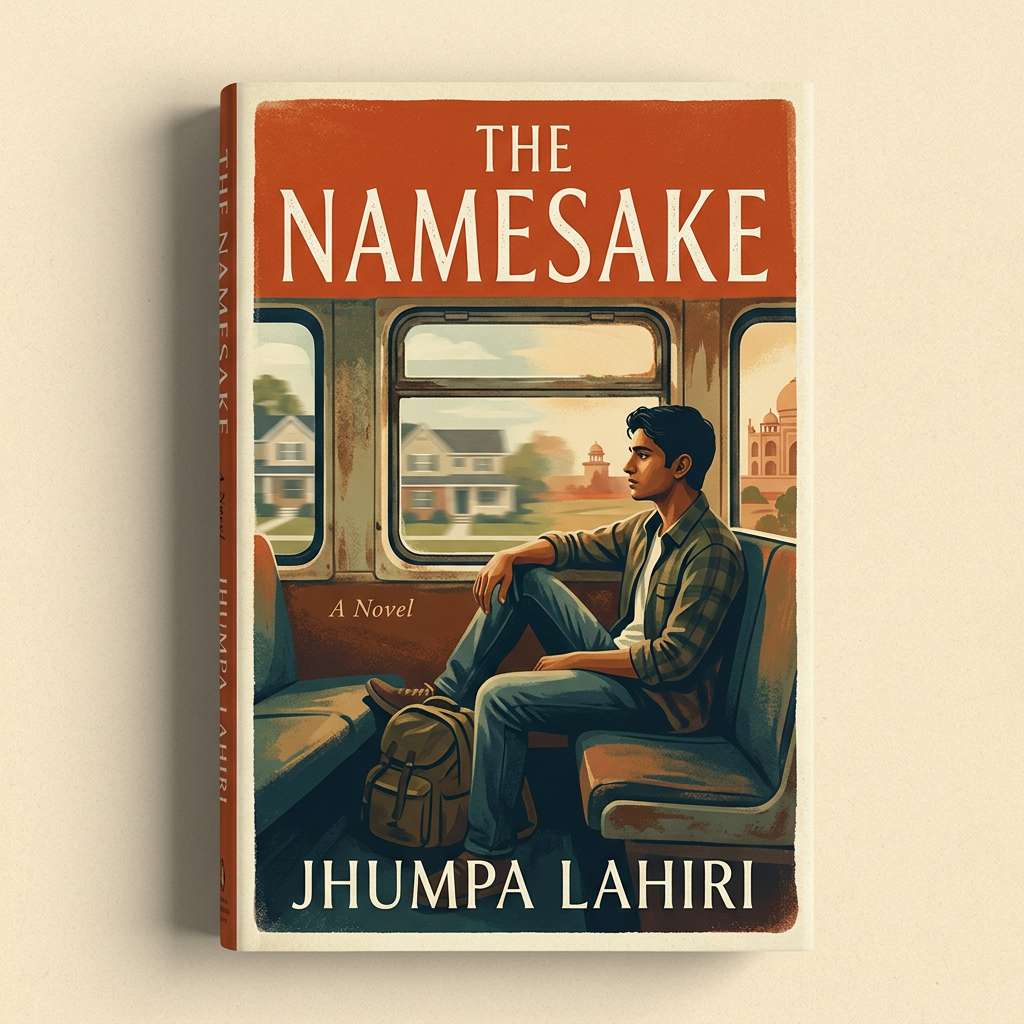
Jhumpa Lahiri — On Names, Distances, and the Weight of Being From Somewhere Else
“That’s the thing about books. They let you travel without moving your feet.”
— Jhumpa Lahiri, The Namesake
What the Book Is About
The Namesake is a novel about a name and everything a name carries. Gogol Ganguli — named, in a moment of parental improvisation in an American hospital, after the Russian author Nikolai Gogol — grows up in Massachusetts caught between two worlds: the Bengali world his parents Ashoke and Ashima have imported with meticulous care from Calcutta, and the American world that simply is, unavoidable and enormous, outside their front door in Cambridge.
The novel follows Gogol from childhood to adulthood as he attempts to shed his name and, with it, the entire inherited architecture of his identity — the food, the rituals, the obligations, the expectations, the particular guilt of a child who finds his parents’ world both precious and embarrassing, sometimes in the same dinner. He changes his name to Nikhil. He dates American women who cannot understand why he has to go home so often. He becomes an architect. He does not, for a long time, understand why his father gave him that name, and the reason, when it comes, is one of the most quietly devastating revelations in contemporary fiction.
Lahiri writes about the hyphen in Indian-American with the precision of someone who has lived inside it, which she has: born in London, raised in Rhode Island, she is perhaps the finest cartographer of the emotional geography that exists between where you come from and where you end up.
A Personal Reading
I read this book in a monsoon June — or began it then, on the bus home through Bangalore’s beautiful, chaotic wet season, the windows fogged and the city outside doing its usual thing of being simultaneously maddening and magnificent. I carried it in my bag for weeks, reading it in installments: on lunch breaks, in waiting rooms, on Sunday mornings when the apartment was quiet and the chai was strong.
What it did to me, slowly and without announcement, was make me think about names. Not just the names we are given but the ones we choose, and the ones we are assigned by circumstance, and the distance between all of them and whoever it is we actually are. Gogol’s parents pack up their entire world — their language, their food, their music, their grief, their particular way of being Indian in a place that has no category for it — and carry it to Massachusetts. And then their son, raised in the carrying, finds it heavy.
This is not a criticism. This is just what happens. This is The Namesake’s great subject: not assimilation or identity in the abstract, but the specific, daily, undramatic difficulty of being the child of people who came from somewhere else and brought everything with them.
What Stays With You
The revelation about Gogol’s name — why Ashoke gave it to him, what it carries, what it meant in the moment of its giving — which I will not reveal here because it deserves to arrive in the book, in its own time, with its full weight intact.
And Ashima standing in a Cambridge kitchen making something like the food she grew up with from the ingredients America has provided, which are not quite the right ingredients but are what there is, which is, come to think of it, the whole novel in a paragraph.
P.S. — The book was made into a film by Mira Nair. Both are beautiful. Read the book first.
P.P.S. — Lahiri later moved to Rome, learned Italian, and began writing in it. Her book about this is called In Other Words. The woman contains multitudes.







Leave a Reply