
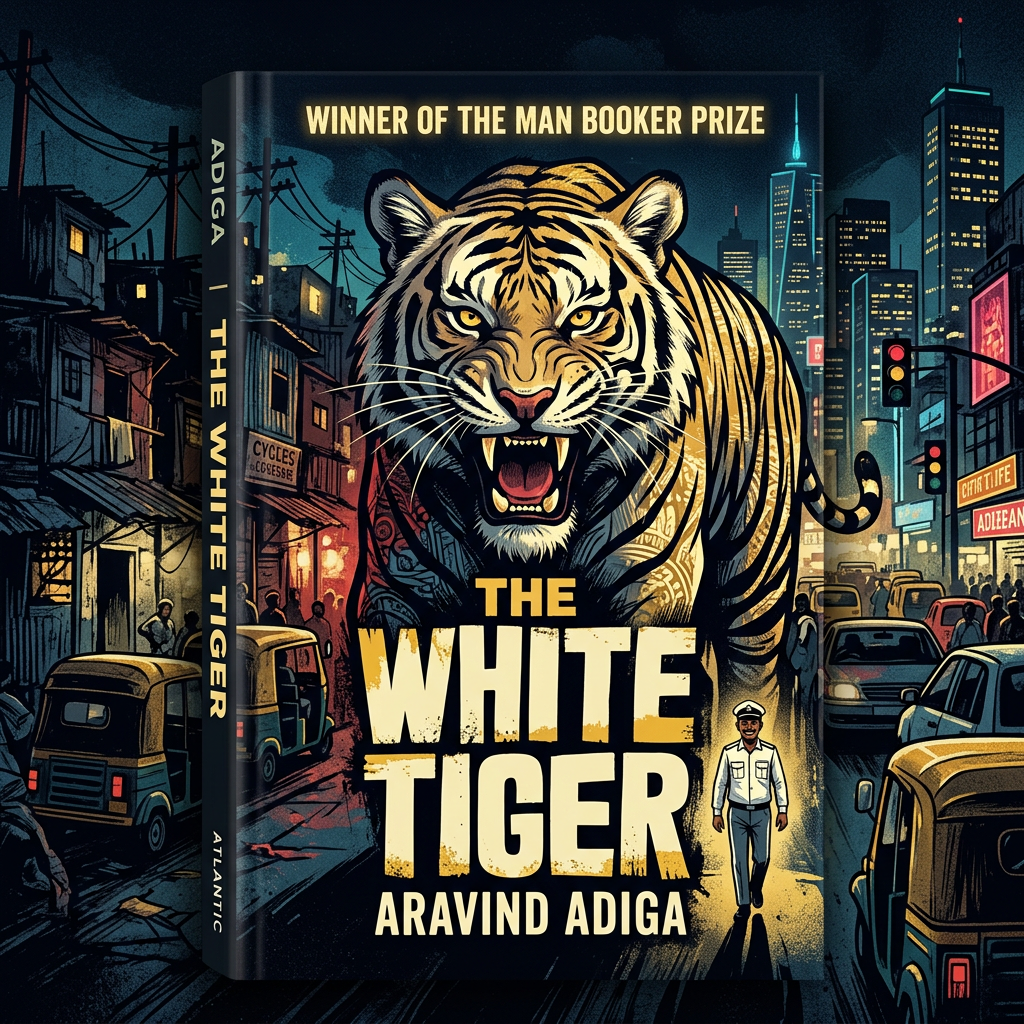
Aravind Adiga — On Roosters, Cages, and the One Who Got Out
“The moment you recognize what is beautiful in this world, you stop being a slave.”
— Aravind Adiga, The White Tiger
What the Book Is About
Balram Halwai is a murderer. He tells us this on the first page. He is also, by the time we meet him, a successful entrepreneur in Bangalore’s technology sector, writing letters to the Premier of China from his air-conditioned office. The White Tiger is, among other things, a story about how a person gets from the first sentence to the second.
Balram grows up in the Darkness — Adiga’s name for rural India, where poverty is not a condition but an inheritance, passed down through generations with the same reliability as surnames — and makes his way to Delhi as a driver for a rich family. In Delhi, he encounters the India of the Light: the malls and the restaurants and the call centers and the enormous, gleaming confidence of a country telling itself it is rising. The two Indias exist side by side, separated not by geography but by the Rooster Coop — Balram’s name for the system that keeps the poor exactly where they are, not through force but through the quiet conspiracy of obligation, family, and the inability to imagine otherwise.
Balram imagines otherwise. The consequences are dark, irreversible, and told with a dark humour so dry it takes several pages to realise the book is also very funny.
Adiga won the Man Booker Prize with this novel in 2008. The literary establishment was, as I understand it, somewhat surprised. They should not have been.
A Personal Reading
I read The White Tiger in one of those periods where Bangalore felt simultaneously exciting and exhausting — the city expanding in every direction, cranes on every skyline, new tech parks rising from fields that had been something else a year ago, and in between all of this the autorickshaws and the street vendors and the construction workers who were building the new India and could not quite afford to live in it.
Balram drove through this city before I did. He observed it from the front seat with the particular clarity of someone who is invisible to the people in the back, and therefore sees them more completely than they see themselves. His observations about the rich — about their carelessness, their assumptions, the ease with which they misplace moral responsibility — are delivered in the tone of a man who has been watching carefully for years and is now, finally, writing it all down.
The Rooster Coop image stayed with me most: chickens in a market, watching other chickens being slaughtered, and not running. Not because they cannot, but because they have accepted the cage as the natural order of things. Adiga is asking: what does it take to see the cage? And once you see it, what are you willing to do?
What Stays With You
The see-saw image of the Indian dream: the poor dream all their lives of eating enough and looking like the rich. The rich dream of losing weight and looking like the poor. Nobody is exactly where they want to be, and the system survives on this mutual dissatisfaction.
And Balram’s voice: sardonic, precise, occasionally warm, always honest in the way that only someone with nothing left to lose can be entirely honest.
P.S. — The book was adapted into a Netflix film in 2021. It is good. The book is better. This is almost always true.
P.P.S. — Balram asks, at one point: ‘I was looking for the key for years, but the door was always open.’ This is a line that has no business being this funny and this devastating simultaneously. And yet.




Leave a Reply