
A Memoir in Three Embarrassments and One Apology
I. Saturday Night, Amazon Prime, and an Unexpected Ambush
It was the kind of Saturday that arrives with no particular ambition — the sort where the sofa has already won the argument by 8 p.m. and the ceiling fan hums its slow, indifferent philosophy above you. I had surrendered to it gracefully, armed with a bowl of leftover dal and the remote control, the twin weapons of a man at peace with his own mediocrity.
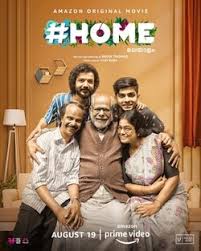
That is when Amazon Prime, in its infinite algorithmic wisdom, served me a Malayalam film called Home. No dramatic trailer, no celebrity endorsement. Just the quiet confidence of a thumbnail: an ordinary man, somewhere in Kerala, wearing a hearing aid that looked like it had been borrowed from a 1987 government hospital, holding a mobile phone as if it were a live grenade.
I pressed play. I did not expect what followed.
The film’s protagonist is named Oliver Twist — not the Dickensian orphan, but an aging Keralite father played with devastating simplicity by the actor Indrans, a man whose face appears to have been weathered by equal parts coconut sun, unsolicited advice, and love that nobody asked for. Oliver Twist’s son has become a writer in the city, a young man who has traded the smell of his mother’s fish curry for the more fashionable aroma of cold brew and creative frustration. The father, meanwhile, is trying to learn technology. He is failing. Enthusiastically.
Somewhere between the father’s fourteenth accidental screenshot and his son’s second theatrical sigh, I set down my dal. Not because it was bad — it was perfectly adequate dal — but because something in my chest had started doing something it had no business doing on a Saturday night.
I was remembering my father.
II. The Hearing Aid, the Hindi Teacher, and the Great Shame of Standard Six
My father was not a man of small presence. He filled rooms with warmth the way a gas cylinder fills with pressure — steadily, invisibly, and with occasional risk of explosion at family gatherings. He was a government servant in a small North Indian town, a man of routine so disciplined that you could set your watch by his 6 a.m. cough and his 7 p.m. news. He laughed too loudly at his own jokes. He used English in the manner of a man defusing a bomb: carefully, with great concentration, and not always successfully.
And he wore a hearing aid.
In the late 1980s, this was not a sleek, discreet, Bluetooth-enabled miracle that hides tastefully behind the ear. This was a beige, slightly humming, proudly analog device that looked as though it had been designed in consultation with a transistor radio. It had a wire. It had a volume dial. On certain atmospheric days, it picked up All India Radio.
I was eleven years old, in Standard Six, at a government middle school in a town where everybody knew everybody and gossip travelled faster than the 6:15 bus to the district headquarters. I was at the age when one’s social reputation is a matter of existential urgency — when the wrong shoes, the wrong pencil box, or God forbid, the wrong parent could annihilate one’s standing in the schoolyard hierarchy for the entirety of the academic year.
It was, of course, on the day of the Annual School Sports Prize Distribution that my father arrived to collect me.
He was wearing his best kurta — the cream one with small embroidery that my mother had ironed with the devotion of someone preparing a religious offering. He had applied hair oil with enthusiasm. He was smiling the smile of a man who has arrived somewhere important and is glad to be there. And there, clipped to his ear, gleaming faintly under the November sun of Agra, was the hearing aid.
My Hindi teacher, Mrs. Sharma — a woman built of starched saris and unsolicited moral instruction — spotted him and walked over. “Your father?” she asked me, already extending a hand toward him.
What I did next is the thing I am not proud of. I stepped slightly to the left. Not dramatically. Not far enough to be undeniable. But far enough, in the geometry of eleven-year-old cowardice, to create a small, plausibly deniable gap between myself and the man who had woken up at five that morning to iron his best kurta to come and watch me receive a Certificate of Participation for the sack race.
“Yes,” I said, a half-second too late. “That is my father.”
My father greeted Mrs. Sharma with tremendous warmth and a sentence in English that had three words correctly placed and one magnificent improvisation. Mrs. Sharma, to her credit, understood him entirely and replied with equal warmth. My father beamed. He was so happy. He was embarrassingly, heartbreakingly happy.
I received my Certificate of Participation. It was for the sack race. I had come third. There were three participants.
My father told everyone he met for the next week that I had won a prize at school.
III. The Grammar of Love We Never Studied
The film Home — which I continued watching on my Saturday sofa while my dal grew cold and my conscience grew warm — is built on a question so simple it takes nearly two hours to answer: what happens when the people who love us most become, somehow, the people we are most uncomfortable to be seen with?
Oliver Twist’s son in the film has constructed a life that looks, from the outside, like success. He lives in Kochi, in a flat with a bookshelf arranged for aesthetics rather than reading. He has opinions about cinema. His friends are the sort of people who say “curated” without irony. He posts on social media with the careful nonchalance of someone who has spent forty-five minutes achieving it.
His father, meanwhile, is in the family home in a village outside Thrissur, trying to video-call him on WhatsApp and accidentally calling the neighbour’s daughter instead. He has made her his phone’s wallpaper by mistake. The daughter is understandably perplexed.
But here is the thing the film understands, and that I was slowly, belatedly understanding on my sofa: the father was never the problem. The problem was the idea of the father — the idea that who we come from might somehow diminish who we have become. The embarrassment, when you trace it back to its source, is not about the hearing aid or the imperfect English. It is about fear. Fear that we might be seen. Fear that our ordinary origins might complicate the extraordinary story we are busy telling about ourselves.
My father, who never studied past Class 10, who learned English from a government-issued dictionary and the backs of medicine bottles, who wore that hearing aid every day without a single visible trace of self-consciousness — my father was, by any honest measure, a man of far greater courage than the eleven-year-old who shuffled slightly to the left to avoid introducing him.
He never asked me to be proud of him. He simply was who he was, and he left room for me to become whoever I wanted to be, and he told people I had won a prize at school even when the prize was for coming last in a sack race, because to him there was no version of his child that was not worth celebrating.
IV. The Ordinary, and Its Quiet Enormity
There is a scene near the end of Home that I will not spoil, except to say that it involves a letter, a son, and the particular silence of a man who has been seen, finally, for what he is. I watched it on my sofa in the dark. The ceiling fan continued its philosophy. Outside, somewhere in the city, someone was having a very successful dinner party.
I thought about the way we arrange our lives to look significant from the outside — the curated photographs, the careful mentions of the right restaurants, the studied casualness of the successful. We become so occupied with the performance of an extraordinary life that we forget to actually live it. We forget that the people who already love us require no performance. They are the audience that stays in their seats regardless of the reviews. They are, in fact, the only audience that matters.
I thought about my father’s hearing aid, humming faintly. I thought about how he had tuned his whole life — amplified it, adjusted it, turned up the volume on the world around him — just so he would not miss anything. Not a word. Not a conversation. Not a prize ceremony for a sack race.
And I — with all my hearing intact — had spent years not quite listening.
Home ended. The credits rolled over a gentle song. I sat for a moment in the specific stillness that a good film leaves behind, the kind that feels like a question you are not yet ready to answer but cannot stop turning over in your hands.
Then I did what one does, in 2024, when one has had a feeling. I picked up my phone. I found my father’s contact. I pressed call.
He answered on the first ring. He always answers on the first ring.
“Are you eating?” he asked immediately, before I could say a word. “You don’t eat. I can always tell.”
“I’m eating,” I said.
“What are you eating?”
“Dal.”
A pause. The unmistakable sound of his evaluation. “Cold?”
“Yes,” I admitted.
“Heat it up. Cold dal gives gas.” And then, without transition, without needing one: “Have you eaten fruit today?”
I laughed. He laughed. We talked for forty minutes about nothing in particular and everything that mattered, the way only people who have known each other for a long time can.
He said, before we hung up: “Call more often. You don’t call enough.”
“I will,” I said. And I meant it this time.
P.S. — Home is on Amazon Prime. Watch it on a weekend when you have nowhere to be and someone to call afterward.
P.P.S. — I came third in the sack race. There were three participants. My father told everyone I won.
P.P.P.S. — I am still, in some ways, working on the apology.





Leave a Reply